Stop Feeding the Algorithm Crumbs: Why Human-First Content Still Wins in the Age of AI Search

Quick confession before we get into it: I used Claude to help me write an article about keeping humans at the centre of content. Yes, I see the irony.
The thinking itself comes from my own research, notes and conversations I've been having around AI, search and content. I used Claude to help bring that material together, organise the research and track down the sources behind it.
And actually, that distinction is kind of the point.
The trend I can't unsee
Across B2B and agency feeds right now, brands are taking perfectly good pages and hacking them into fragments. Isolated blocks. Orphaned bullet points. Snippets designed, supposedly, so an AI crawler can scrape them more easily.
I get the instinct. I think it's backfiring anyway.
Search engines and AI systems don't need your writing butchered to understand it. reading deep, multi-topic pages is basically what they're built to do. Shred your narrative for machine parsing and you don't gain anything with the AI. You just lose the human who was actually reading it.
Clear headings. Logical journeys. Complete ideas, told properly. That was good practice before generative AI search existed, and it still is now. Which is, genuinely, why I sat down to write this, not because it's a tidy line to end a LinkedIn post on.
Where this actually plays out: Future Talent Learning
We rebuilt the Future Talent Learning site with that exact tension sitting in the middle of the brief. FTL needed content that worked hard for SEO but was still genuinely useful to the HR and L&D leaders trying to make sense of a fairly complex offer. Not content written for a crawler and grudgingly tolerated by a person.
The unlock wasn't volume. It was format, specifically, a clear FAQ/Q&A structure on key pages. Turns out that's brilliant for AI answer engines for exactly the same reason it's brilliant for a busy human scanning a page: a direct question, a direct answer, no padding either side of it. We didn't build it for the bots. We built it for the person trying to get an answer at 4pm on a Tuesday, and it happened to be exactly what the bots wanted too.
The numbers hold up: overall website traffic up 322% since launch, organic search up 151%, and the site now leads Semrush's "Game Changers" quadrant across every market it's measured in. Roughly a quarter of that traffic now comes via AI assistants. Writing well for humans and showing up in AI answers, in other words, aren't two different jobs.
We're building on it now with a proper run of blog posts and whitepapers, going deeper into the topics the FAQ format only has room to summarise.

Are we now using AI to write for AI?
Here's the bit I actually sat with while writing this. If we're producing content partly to be picked up by AI search, and using AI tools to help write that content, where's the human?
Not nowhere. But it's worth saying plainly where AI helped here: pulling research, checking sources and a first pass at structure. The human part sits elsewhere: the argument, which examples made the cut, the editing, and putting my name to the finished thing. That last part, a named person taking responsibility for AI-assisted content, is starting to matter legally as well as ethically. More on that shortly.
If a piece of content has no point of view and nobody willing to own it, that's the real problem. Whether AI touched the keyboard along the way is a much smaller question.
SEO, UX and CRO have always put the human first
Good SEO, UX and CRO has never really optimised for the algorithm as an end in itself. It optimises for the person, on the reasonable theory that search engines have always been trying to model what a person actually wants. Ranking well was a proxy for serving someone well. It was never the goal by itself.
Generative AI search hasn't changed that. Google's first official guide to optimising for its generative AI search features, published in 2026, states it about as plainly as a search company ever states anything: optimising for generative AI search is optimising for the search experience, full stop. Still SEO. Same foundations underneath.
What's changed is format and measurement, not the audience. AI engines favour a self-contained, well-reasoned answer over a fragment, which is exactly why FTL's FAQ approach worked. New visibility metrics, citation rate and mention share among them, now sit next to the old ones (rankings, click-through rate), not instead of them. And there's decent evidence, including reporting from the Financial Times on how AI is reshaping search behaviour, that AI-generated answers lean heavily on what other people say about you: reviews, independent write-ups, third-party coverage, rather than on your own pages alone. Which is really an argument for PR and genuine reputation over yet more on-page tricks.
So it was never humans versus AI. Write something complete and useful for a person. Structure it so both humans and machines can follow it. Then earn the kind of reputation that gets you mentioned when an AI is answering somebody else's question.
The law is starting to expect a human too
Since 2 August 2026, Article 50 of the EU AI Act has introduced new transparency requirements around AI-generated content. There’s plenty of detail behind it, but one part feels particularly relevant here.
For AI-generated text on matters of public interest, there’s an exemption from disclosure where a human has genuinely reviewed the content, exercised editorial control and taken responsibility for what gets published.
That’s the bit I find interesting. It draws a distinction between using AI as a tool and handing the job over to it.
AI can help with research, sources, structure and drafts. But there still needs to be someone making the argument, deciding what matters, editing it properly and ultimately putting their name to it.
The rules are different for AI-generated images, audio and video, where separate transparency requirements apply.
It’s a useful test regardless of whether the legislation applies to you: could a real person honestly say they reviewed this, shaped it and stand behind what it says?
Nobody's actually in charge here
Zoom out, because this is the backdrop to everything above. We recently built the site for Global Citizens' Assembly, an organisation working on exactly this: AI governance specifically, plus climate and global health. Their research, convened through the Iswe Foundation, makes an argument I keep coming back to: AI governance right now has a real democratic deficit. A small number of governments, companies and technical bodies are making calls that affect billions of people who've had almost no say in any of it. Public trust in AI has been falling even as usage climbs, and evidence of AI's real-world impact keeps lagging its deployment. Regulators are still assessing yesterday's model while today's is already out.
There are reportedly around 450 distinct AI governance initiatives globally at the moment, most of them disconnected from one another. The UN only convened its first Global Dialogue on AI Governance in 2026.
The point for anyone making content decisions: the rules on what you must label, what you can claim, what counts as acceptable AI use; they're being written in real time, unevenly, by institutions that admit openly they're behind the technology. Not a reason to freeze. A reason to build ahead of the law, rather than waiting for it to catch you up.
And it keeps getting faster
Some scale for context, because it's easy to underestimate even when you're trying to pay attention. The telephone took 46 years to reach a quarter of US households. Radio and television took two or three decades each. Even the mobile phone and the PC, both fast by the standards of their day, took well over a decade to go properly mainstream.
Epoch AI's research on technology diffusion shows this shrinking isn't random: the time for a new technology to reach majority adoption has been falling for over a century, from roughly 40 years in 1900 to around 17 by 2000. Extrapolate that line and AI was already on track to be the fastest-adopted technology ever. Then it beat the extrapolation. ChatGPT hit 100 million users in a little over two months, according to a widely cited UBS analysis, nine months faster than TikTok managed the same number.
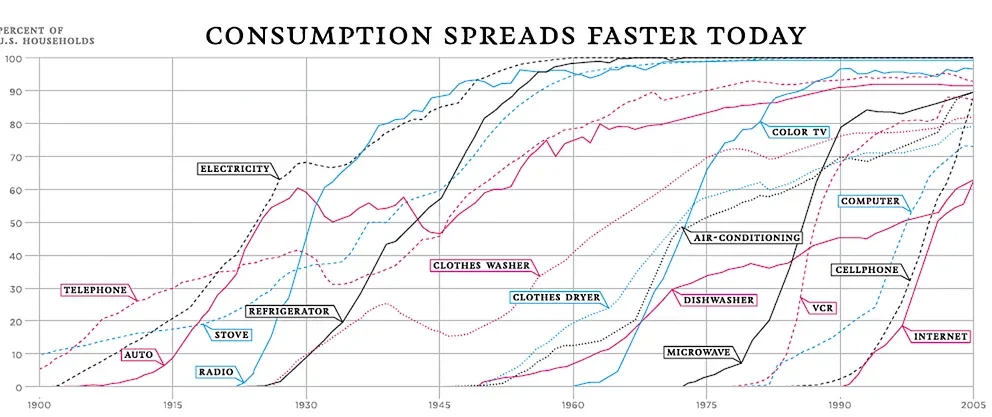
The percentage of US households that use a technology over time, for a range of different technologies. Most of these technologies are consumer electronics that have been especially notable over the 20th century. Source: Andrew Gelman
But adoption is only part of it. The technology itself is moving incredibly quickly too. New models, tools and capabilities arrive constantly. What felt cutting edge six months ago can feel fairly ordinary now. At times, it can feel like the conversation changes by the hour.
That makes staying on top of it everyone's problem. As users, we need to understand what these tools can and can't do. As businesses, we need to keep testing where they genuinely add value rather than chasing every new release. And governance has to find ways of protecting people without regulating a version of the technology that's already moved on.
None of those are easy. But keeping up, questioning what’s changing and being willing to adapt is probably our best chance of finding the right solutions as AI develops.Where that leaves us
Write the complete, useful thing first, for a human. Structure it clearly. Say plainly where AI helped and where the judgement is yours. Label AI-assisted content to the strictest standard already in force, not the one you can currently get away with. And don't anchor your whole strategy to any single platform's roadmap, because, as the FTL numbers show, the thing that actually works hasn't changed. Something worth reading, told well.
Where that leaves us
So, back to the question I started with: are we writing for humans or machines?
For me, it still has to be humans first. Write the complete, useful thing. Structure it clearly. Use AI where it genuinely helps, but keep human judgement, editing and responsibility at the centre of it.
Because the interesting thing is that writing for humans and being understood by AI aren't opposing goals. As the FTL work shows, clear, useful, well-structured content can do both.
The technology will keep changing. Search will change. The rules will change too, probably faster than any of us would like. We need to keep learning and adapting as users, businesses and those shaping governance.
But we don't need to start writing for machines to keep up with them.