

Every marketing team falls into one of three operating models. Only two of them survive.
The difference comes down to how a team balances speed against perfection, and whether its leadership has made that choice deliberately or let it happen by accident. Here is how the three models play out in practice.
Why this question matters right now
Speed is no longer a nice-to-have. In research published by Stensul in 2026, 47% of marketing teams said they were now measured on faster time-to-market or increased campaign velocity. Leadership wants more, and it wants it sooner.
The pressure is landing on people. Marketing Week’s 2026 Career & Salary Survey, based on 2,350 responses, found that 60.7% of marketers feel undervalued and 55.1% are emotionally exhausted. Separate research from the Chartered Institute of Marketing found that 51% of UK marketers fear burning out in their current role.
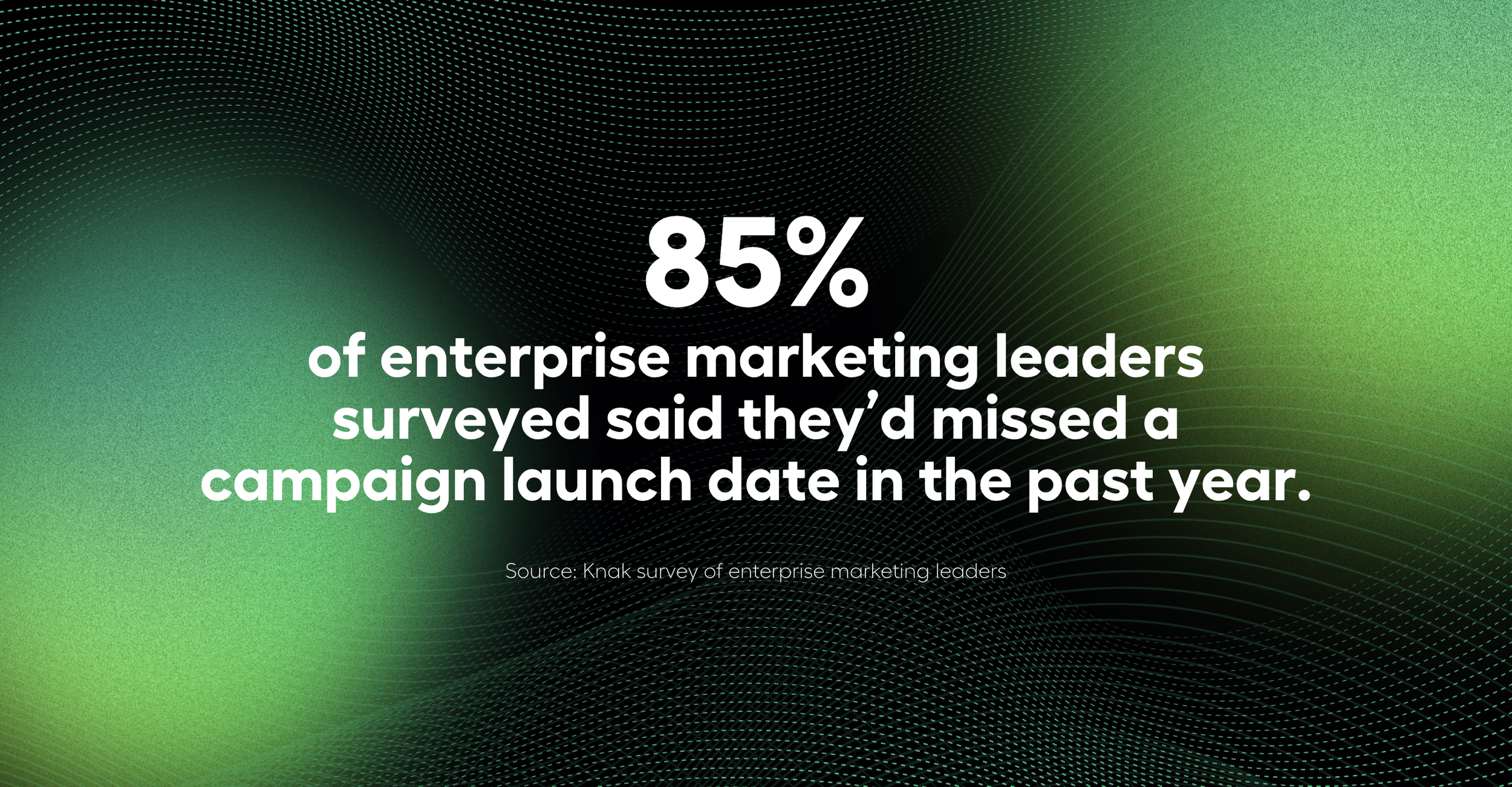
And the extra pressure is not always buying faster delivery. A Knak survey of enterprise marketing leaders found that 85% had missed a campaign launch date in the past year. The causes were mostly operational rather than creative: approvals and sign-off, design and creative production, and coordination across teams.
Read together, those figures describe a gap. Leaders are asking for velocity, teams are running hot, and the real delays sit in how work is reviewed and approved. That gap is exactly where the three operating models part company.
1. "Ship & Iterate": The bias for action
These teams move fast. Mistakes happen, and a typo might slip into an email, but momentum wins. Rather than polishing in isolation, they learn from real market feedback and improve with every release.
The upside goes beyond speed. Creative talent tends to thrive under this kind of autonomy, because people are trusted to make decisions and get their work out into the world.
Ship & Iterate works best when the team agrees what “good enough” means before the work begins. A typo in a social post or a mid-week newsletter is cheap to fix and quickly forgotten. What the team learns from real audience behaviour, such as opens, clicks, replies and shares, is worth far more than another round of internal opinion.
Speed on its own is not the point. The value comes from shortening the loop between an idea and evidence about whether it works. Teams that ship small and often get more attempts, and each attempt teaches them something that no review meeting could.
The risk is carelessness. Fast teams need a short list of non-negotiables, such as legal claims, accessibility, brand basics and anything touching sensitive data. That way autonomy never means skipping the checks that genuinely protect the business.
2. "The Gold Standard": Uncompromising precision
In this model, every sign-off takes three weeks. Output is lower and timelines are long, but brand reputation remains flawless and the work that does go out is world-class.
It is a legitimate choice, and for some brands and some kinds of work it is the right one. The trade-off is simply that precision costs time, and the team has to be set up to absorb that.
Where this model earns its reputation is work that is hard to reverse or highly visible: a rebrand, a flagship campaign, a regulated announcement or a high-stakes launch. When a mistake would be expensive, public or permanent, careful review is simply good risk management.
The problem is that approvals tend to creep. Industry research keeps pointing to review and sign-off as one of the biggest drags on marketing delivery. In the Knak survey, approvals and sign-off were named among the top causes of missed launches. A Storyblok benchmark reported by The Starr Conspiracy found approval processes to be the leading bottleneck for more than half of the teams it surveyed.
It also helps to separate two kinds of perfectionism. Psychologists distinguish perfectionistic strivings, which means holding yourself to high standards, from perfectionistic concerns, which means worrying about mistakes and other people’s judgement. A meta-analysis of 43 studies by Andrew Hill and Thomas Curran found that strivings had little or even a slightly protective link with burnout, while concerns had a medium to large link with it. The Gold Standard works when it is driven by the first. It starts to hurt when it is driven by the second.

View or work for NHS Charities Together where we felt the it important to spend the time to perfect the quality of this short film
3. "The Toxic Pressure Cooker": The hybrid trap
This is the model that does not survive. Leadership demands absolute perfection, but wants it delivered by end of day.
The result is predictable. Creatives burn out, sign-offs stall, and quality plummets under unsustainable stress. The team ends up with neither the speed of the first model nor the polish of the second.
The research on time pressure is uncomfortable reading for any leader who believes tight deadlines sharpen creativity. Harvard Business School’s Teresa Amabile and her colleagues analysed more than 9,000 daily diary entries from 177 employees across seven companies. On the days of greatest time pressure, people were 45% less likely to think creatively. The effect also lingered for a couple of days afterwards, a pattern Amabile called a time-pressure hangover.
Perhaps most telling, people did not notice. Participants felt more creative on high-pressure days, even though their diaries showed the opposite. Teams in the Pressure Cooker can easily mistake being busy and wired for being at their best.
The perfection half of the equation carries its own cost. A 2025 meta-analysis by Bellam and Curran, covering 26 studies and nearly 10,000 workers, found that perfectionistic employees put in longer hours, but the extra hours did not reliably translate into better performance, particularly where fear of mistakes was the driver. In short, perfectionism makes people busier, not necessarily better.
Combine the two demands and you get the worst of both worlds: the long hours of perfectionism without the time to do it properly, and the drop in creative thinking that comes with extreme deadlines. A 2026 tmp survey of 1,000 marketers and technology buyers in the UK and US found that 53% described their working environment as chaotic, and almost three quarters said they were not sleeping properly. None of that produces world-class work.
What strong leadership looks like
Strong leadership is not about demanding perfection on everything. It is about knowing which projects require perfection and which require speed.
A homepage rebrand and a weekly social post do not deserve the same level of scrutiny. Treating them as equals is how teams drift into the Pressure Cooker.
And if your team does need flawless precision, make sure you are budgeting the time and resources to match. Perfection is achievable, but it is never free.
Five habits that keep teams out of the pressure cooker
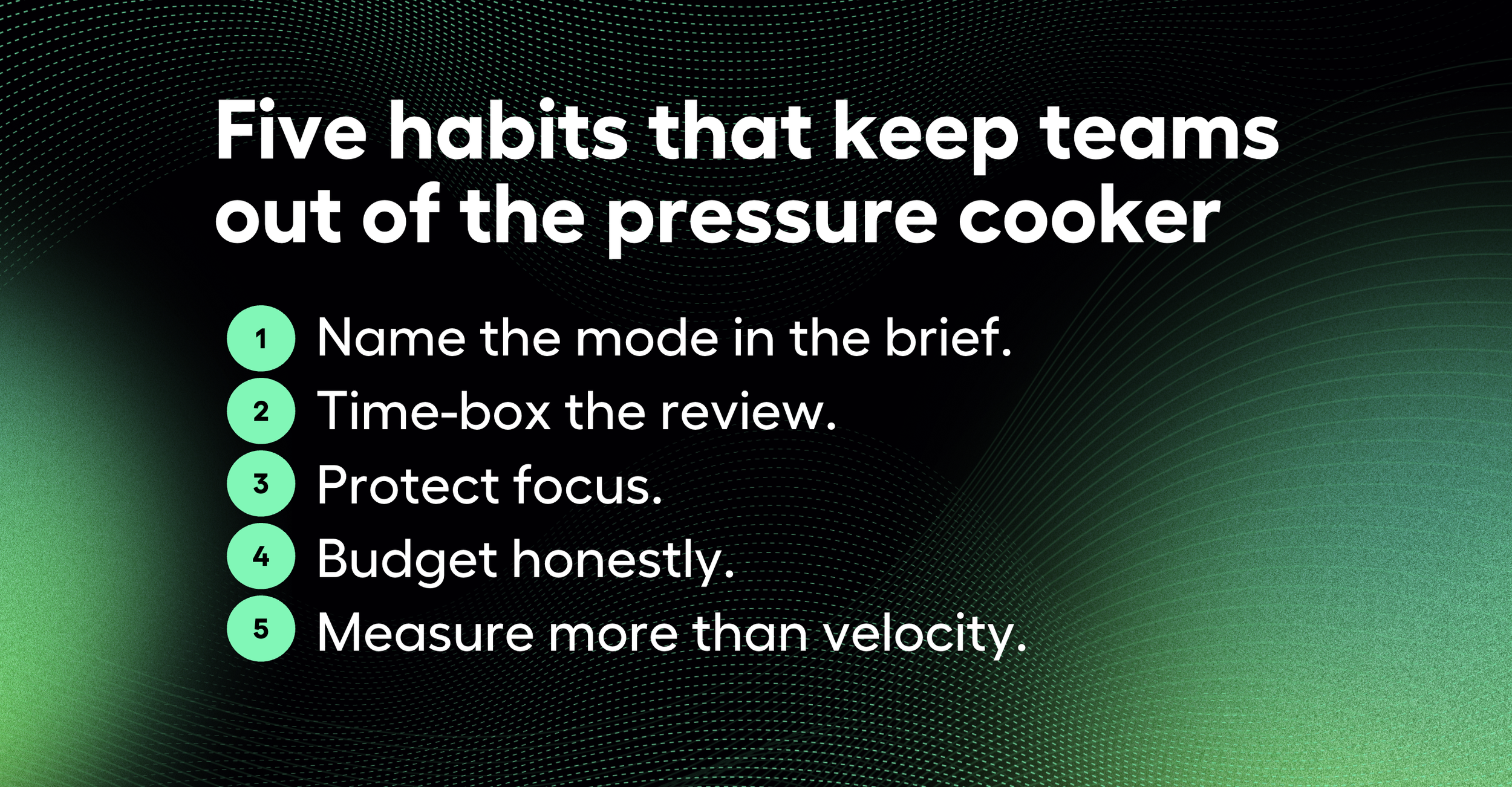
Name the mode in the brief. Put “ship fast” or “gold standard” at the top of every brief, so nobody has to guess how much polish is expected.
Time-box the review. Limit the rounds of feedback, name the approvers and set response windows. One 2026 industry analysis found that half of surveyed enterprise teams still ran sign-off through chat threads, which is a recipe for stalled work. Give approval routing a named owner.
Protect focus. Amabile’s research found that creativity can survive a tight deadline when people can concentrate on one task they believe really matters, without constant interruption. Explain why the deadline exists, then clear the diary.
Budget honestly. If a project needs flawless precision, build the time, people and buffer into the plan from day one. A perfect result on an impossible schedule is a promise nobody can keep.
Measure more than velocity. Track cycle time and the number of revision rounds, but pair them with signals about the team’s wellbeing. A fast team that is quietly burning out is borrowing from next quarter.
Which model is your team running?
Take an honest look at how your marketing team currently operates. Are you shipping and iterating, holding to a gold standard, or quietly stuck in the hybrid trap?
A few questions can help you decide:
When did your team last ship something imperfect on purpose, and what did you learn from it?
How many rounds of approval does a typical email or landing page go through, and does every round add value?
Do your deadlines and your quality bar actually match the time and resources you have given the team?
Do your people know, at the start of a project, whether it needs speed or perfection?
We would love to hear your thoughts.
Sources
Chartered Institute of Marketing burnout research, reported by Research Live (December 2023)
Knak survey on missed campaign launch dates and Demand Gen Report coverage
Storyblok speed-to-market benchmark, via The Starr Conspiracy
Hill & Curran, multidimensional perfectionism and burnout: a meta-analysis
Bellam & Curran (2025), perfectionism and work performance, summarised by Simply Psychology
Amabile, Hadley & Kramer, Creativity Under the Gun (Harvard Business Review, 2002), summarised by the APA and Fortune
tmp survey on chaos and burnout in marketing, via Decision Marketing (February 2026) and SMEWeb
